REVIEW · OAHU
Downtown Honolulu Self Guided Walking Audio Tour
Book on Viator →Operated by History with Action · Bookable on Viator
A GPS walk through royal and war history. This self-guided downtown Honolulu audio tour links 23+ stories across about 1.6 miles, with stop-by-stop narration that helps you understand what you’re looking at. I particularly like the hands-free, location-triggered audio (no constant tapping) and the chance to keep going at your own pace while the route keeps you oriented.
The main thing to watch is the app setup. If you’re not tech-comfortable, the requirement to download the tour on strong Wi‑Fi/cellular and enter the password correctly can feel like the hardest part—so I’d plan to get your phone ready before you start walking.
In This Review
- Key highlights you’ll care about before you go
- Downtown Honolulu in 1–2 hours: what the route is really like
- Price and value: why $9.99 can make sense in Honolulu
- App setup that can make or break the experience
- Kamehameha to government buildings: your first half of the walk
- King Kamehameha Statue: the dramatic opener
- Kawaiahaʻo Church: the kingdom’s national church story
- The missionary-period museum: a quick historical snapshot
- Aliʻiolani Hale: palace to government offices
- Honolulu Hale (City Hall): the world tour return and political fallout
- Patsy Mink, Sky Gate, and the state’s seat of power
- Patsy Takemoto Mink statue and memorial: a modern figure with deep roots
- Sky Gate by Isamu Noguchi: public art that turns into a puzzle
- Hawaii State Capitol: a forward step that points back
- Pearl Harbor remembrance, royal homes, and Iolani Palace
- Eternal Flame Memorial: a built-in moment of remembrance
- Washington Place: where Queen Liliʻuokalani lived
- Iolani Barracks: royal guard before the coup
- Iolani Palace: the only royal palace in the United States
- Queen Liliʻuokalani Statue: the closing note
- Timing and walking comfort: when to schedule your Honolulu audio walk
- Who this tour is best for (and who should skip it)
- Should you book this Downtown Honolulu audio walk?
- FAQ
- Where does the Downtown Honolulu Self Guided Walking Audio Tour start and end?
- How long does the tour take?
- Is it available only in English?
- Do I need cellular or Wi‑Fi during the walk?
- How do I get the audio to start when I arrive?
- Are the tour stops free to visit?
- Can I pause the tour and resume later the same day?
- What phones or tablets does it work on?
- What if I need to cancel?
Key highlights you’ll care about before you go

- Offline maps and offline audio after you download the tour, so you’re less dependent on signal.
- Location-triggered storytelling that plays as you reach each landmark, keeping the walk flowing.
- Clear walking flow for major sights like Iolani Palace, the Eternal Flame memorial, and Queen Liliʻuokalani’s area.
- Free admission at every listed stop, so you’re paying for the tour experience, not entrance fees.
- Lifetime access with no expiry, meaning you can reuse it on future visits.
- Short, realistic timing: roughly 1–2 hours for the whole route at a relaxed pace.
Downtown Honolulu in 1–2 hours: what the route is really like

This walk is designed to be doable. The distance is about 1.6 miles, and the tour time clocks in at around 1–2 hours depending on how often you pause for photos, shade breaks, and quick looks inside buildings when they’re open.
What makes it feel good is the pacing. The stops are spaced around a compact downtown area and most story segments are around 10 minutes, so you’re not stuck listening to one mega-monologue the whole time. You’ll also get audio cues that guide you from landmark to landmark, which helps a lot in a city where street layouts can feel confusing at first.
Also: you’re not locked into a group schedule. The tour is self-guided, so you can start later in the day (within opening hours), pause if the sidewalks get crowded, and restart when you’re ready. That flexibility matters if you’re combining this with shopping, coffee, or a quick museum visit.
You can also read our reviews of more walking tours in Oahu



Price and value: why $9.99 can make sense in Honolulu
At $9.99 per person, this isn’t priced like a private guide. Instead, you’re buying a “story map” that turns downtown sightseeing into a guided education session you can replay.
Here’s where the value gets real:
- All stops listed are free to access (each landmark shows free admission in the tour info you’re given). So you’re not paying extra on top for entry tickets.
- Lifetime access with no expiry means you’re not using it only once. If you return to Oʻahu, you can run the same route again and focus on parts you rushed the first time.
- Offline use after download is a big deal in Honolulu. It means the experience depends less on luck with phone signal and more on a one-time download before you start.
If you’re the kind of visitor who likes to understand what you’re seeing—why a building matters, what changed, and who made decisions—this is a straightforward way to get that context without hiring a guide. If you just want quick photo stops with minimal reading/listening, you may feel you’re paying for audio you won’t fully use.
App setup that can make or break the experience
This tour runs through Action’s Tour Guide App, and getting it working early is the difference between smooth walking and a frustrating start.
Plan for these steps:
- After booking, you get an email and a text with setup instructions and a password. The instructions may direct you to search for an entry that includes the phrase audio tour.
- You download the Action tour app on your phone.
- You enter the password sent to you.
- Important: you need to download the tour while you’re on strong Wi‑Fi/cellular. After that, it’s meant to work offline.
Once you arrive:
- You open the app at the starting point (Aloha Tower Marketplace).
- If the app shows multiple versions, you pick the one matching your planned starting point/direction.
- Then you walk to the first story point and audio should begin automatically, with subsequent stories triggering by your location.
Two practical tips I’d follow:
- Bring headphones/earbuds. This is an audio walk, not a silent stroll.
- If you’re traveling with someone, you can share one tour by splitting headphones—but only if you’re both okay listening through one phone.
If audio doesn’t start at the first landmark or the map doesn’t match what you’re seeing, you’ll need to contact support. Since there’s no person meeting you at the start, your best move is to troubleshoot on-site quickly rather than continuing for long without audio.
Kamehameha to government buildings: your first half of the walk
The tour starts at Aloha Tower Marketplace and heads toward the core of downtown’s landmark cluster. The earliest stops do an excellent job setting themes: power, changing rule, and how public buildings became story props for the Hawaiian Kingdom era and beyond.
King Kamehameha Statue: the dramatic opener
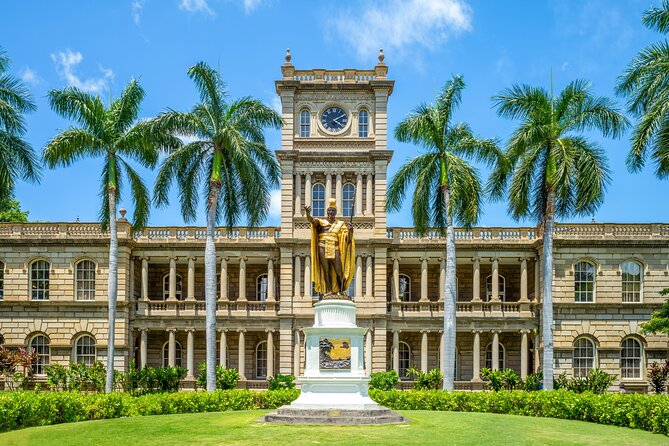
You begin at the King Kamehameha Statue, and the audio doesn’t treat him as a generic monument. It frames him as a figure with real intimidation in the way his contemporaries described him—someone tied to an era of intense conflict among chiefs in the 1700s.
Why this start works: it primes you to pay attention to the idea that Honolulu’s history is not just “old stuff.” It’s about who gained control, how authority spread, and what people built afterward to legitimize power.
Practical note: treat this as your orientation moment. Look around, get your bearings, then keep moving—this tour is at its best when you stay in motion.
You can also read our reviews of more guided tours in Oahu






Kawaiahaʻo Church: the kingdom’s national church story
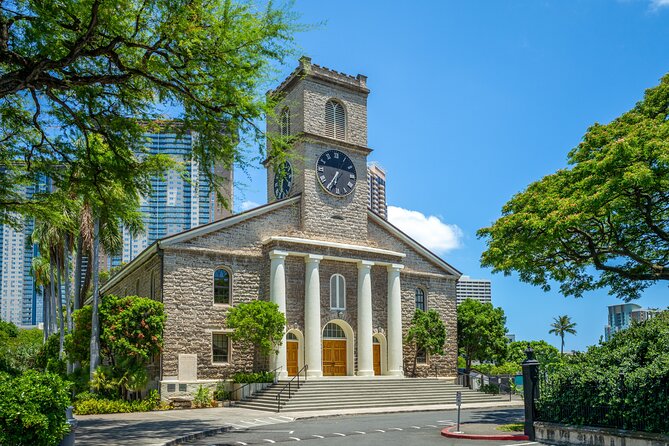
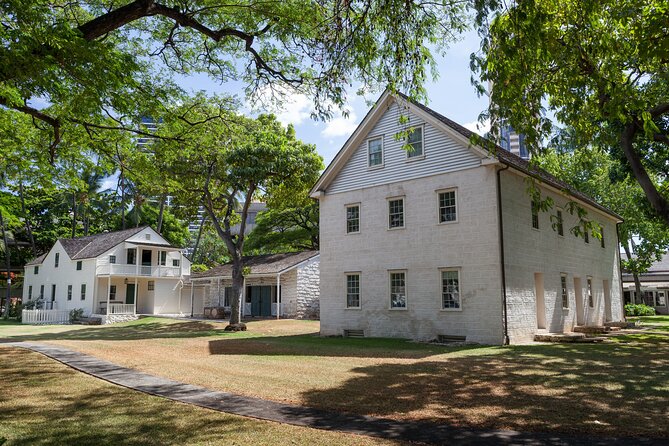
Next is Kawaiahaʻo Church, described as the former national church of the Hawaiian Kingdom. This is one of those stops where the audio adds meaning fast. Without it, you might just notice the architecture and religious significance. With it, you understand the church as a national symbol tied to governance and identity.
If you’re curious about how institutions shaped Hawaiian life, you’ll like this segment. It’s short, but the context makes the building feel less like a background landmark.
The missionary-period museum: a quick historical snapshot
Between the church and the next major civic buildings, the route includes a museum showcasing items from Hawaii’s missionary period. The tour keeps the visit focused. You’re not sent on a long wandering afternoon—you’re pointed at items and asked to connect them to the time period being referenced.
I like this placement in the walk. It gives you a “lens switch” before you move back into royalty and government spaces, so your brain doesn’t treat every stop as the same type of story.
Aliʻiolani Hale: palace to government offices
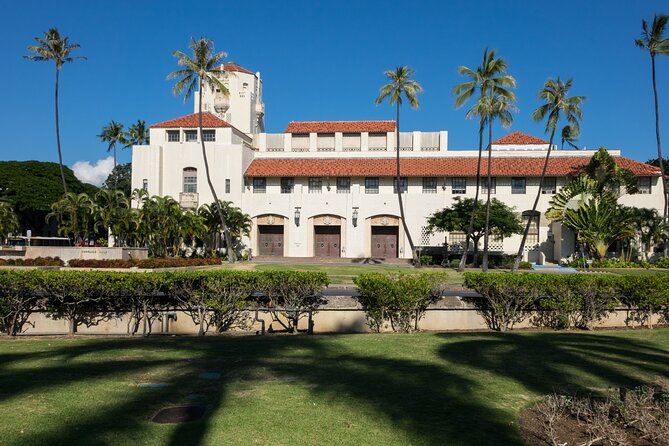
Then you reach Aliʻiolani Hale. The audio explains that King Kamehameha V built it as a palace for Hawaiian monarchs, and later King Kalākaua converted it into government offices.
This is one of the tour’s smartest themes: buildings didn’t just sit there. They changed roles as power changed hands. When you hear that transformation story while standing in front of the building, it makes the place feel alive, not frozen.
Honolulu Hale (City Hall): the world tour return and political fallout
The next stop is Honolulu Hale (City Hall). The story covers King Kalākaua returning from a world tour in late 1881, the city celebrations, and a “welcome home” atmosphere—followed by political plotting and the Reform Party’s growing influence after the 1875 Reciprocity Treaty.
This segment is useful if you want a clearer picture of how external influence and internal politics intersected. You’ll come away knowing that some of the biggest turning points weren’t random events—they were connected to treaties, factions, and organized power moves.
Patsy Mink, Sky Gate, and the state’s seat of power
In the middle of the route, you shift from royal-era and political-government topics to a blend of civic identity and art. That mix keeps the walk from feeling like only one kind of museum exhibit.
Patsy Takemoto Mink statue and memorial: a modern figure with deep roots
At the Patsy Takemoto Mink Statue and Memorial, the audio honors a more recent leader: Representative Patsy Takemoto Mink. You get key background points, including that she was a third-generation Japanese-American who grew up in Hawaii.
Even though the stop is brief, it’s a smart inclusion. It reminds you that Honolulu’s story isn’t just about one century or one type of ruler—it continues through people shaping rights and policy in Hawaiʻi’s modern era.
Sky Gate by Isamu Noguchi: public art that turns into a puzzle
Then comes Sky Gate by Isamu Noguchi. The audio asks what you see: bending black tubes, a spider-web feel, or a three-legged animal shape. It also connects the sculpture to Noguchi’s idea of an evocation to the skies of Hawaiʻi.
This stop is excellent if you enjoy figuring out art with your own eyes. The audio doesn’t force one interpretation; it encourages you to “read” the sculpture as a conversation between the structure and the sky.
Hawaii State Capitol: a forward step that points back
At the Hawaii State Capitol, the tour includes an important historical contrast. Before the Capitol Building existed, Hawaiians used the ʻIolani Palace as their seat of government. The story even tells you you’ll see the palace soon.
This is the kind of context that makes the next segment hit harder. You’re already primed to understand ʻIolani Palace as more than a pretty royal building—it’s tied to how governance functioned.
Pearl Harbor remembrance, royal homes, and Iolani Palace

As the tour nears the end, it moves into spaces connected to sovereignty, the 1941 tragedy, and the royal legacy of Queen Liliʻuokalani. This part lands best if you slow down slightly and let each story register.
Eternal Flame Memorial: a built-in moment of remembrance
The Eternal Flame Memorial honors men and women who died in the December 7, 1941 attack on Pearl Harbor. The audio frames the day as one that would live in infamy, echoing President Franklin Roosevelt’s famous phrasing.
Even if you know Pearl Harbor history already, the memorial placement in a downtown walking route is powerful. It interrupts the earlier royal-political narrative and grounds the day-to-day reality of history’s consequences.
Washington Place: where Queen Liliʻuokalani lived
Next is Washington Place, described as a two-story mansion set back from the road. This was the home of Queen Liliʻuokalani.
What I like about this stop is how it shifts your attention from buildings as symbols of power to a residence tied to ongoing community relationships. The audio emphasizes that Native Hawaiians visited her often, and that her role as queen continued through those connections.
Iolani Barracks: royal guard before the coup
Then you stand before the Iolani Barracks. The audio explains that before Dole and the Annexation Club completed their coup against Queen Liliʻuokalani, these barracks housed the Queen’s Royal Guard.
This is a sobering story, and it adds clarity to a complicated chapter. I like that it’s kept concrete: you’re not just told about political change in the abstract; you’re pointed at the kind of place where power was defended.
Iolani Palace: the only royal palace in the United States
Finally, the route brings you to Iolani Palace, dating back to 1879 and noted as the only royal palace in the United States.
This is often where audio tours earn their keep. With the right narration, a palace becomes a timeline you can stand inside—less about distant monarchy and more about the reality of decisions made here, at this spot, during a pivotal time.
Queen Liliʻuokalani Statue: the closing note
The tour ends at the Queen Liliʻuokalani Statue. The audio tracks how she gradually withdrew from public life in the early 1900s and spent full time at Washington Place, where her people kept visiting.
You also get a line from her memoir, centered on devotion to her people—an idea she expressed as being willing to give everything for them.
This ending matters because it ties together the whole walk. You started with a king known for power in conflict; you end with a queen known for loyalty and love toward her community.
Timing and walking comfort: when to schedule your Honolulu audio walk
Honolulu can heat up fast, especially when you’re walking between landmarks with limited shade. If you can, start earlier in the day. The route runs until 6:00 PM, and the site hours listed for the walking window run 9:00 AM to 6:00 PM.
If you go in the afternoon, plan breaks:
- Duck into shade or open-air lobbies when you can.
- Pause your audio when you need water and then restart when you’re ready.
Your phone battery also matters. Since you’ll be using GPS and audio, keep your charger situation in mind. And since strong Wi‑Fi/cellular is needed for the download, try to handle that before heading out into the midday heat.
Who this tour is best for (and who should skip it)
You’ll enjoy this tour most if:
- You like learning history while walking, not after the fact.
- You want a compact route with big-name sights: Iolani Palace, Honolulu Hale, the Eternal Flame memorial.
- You value offline capability because you don’t want your phone to decide whether the tour works.
- You’re comfortable using a smartphone and following simple app prompts.
You might think twice if:
- You hate app setup or you don’t want to deal with password and download steps.
- You need a person to guide you turn-by-turn. This tour gives directions through audio and map cues, not a staff member at the sidewalk corner.
Should you book this Downtown Honolulu audio walk?
If you’re okay with phone-based self-guided touring, this is a strong pick. For $9.99, you get a compact walk through downtown’s most meaningful landmarks, with location-triggered narration and offline support after download. The route is short enough to fit into a half day, and the topics connect well: Hawaiian leadership, government changes, modern civic identity, and Pearl Harbor remembrance.
I’d book it if you want context without spending guide money—and you’re willing to do one prep step: download the tour on strong Wi‑Fi/cellular and make sure you can enter the password cleanly before you start.
If you’re traveling with someone who hates tech, you’ll still be able to do it, but I’d make setup a team activity before you leave the area.
FAQ
Where does the Downtown Honolulu Self Guided Walking Audio Tour start and end?
It starts at Aloha Tower Marketplace (Aloha Tower Dr, Honolulu) and ends at the Queen Lili‘uokalani Statue (21024001, Honolulu).
How long does the tour take?
Plan on about 1 to 2 hours to complete, with the route noted as about 1.6 miles long.
Is it available only in English?
Yes, it’s offered in English.
Do I need cellular or Wi‑Fi during the walk?
You’re meant to download the tour first on strong Wi‑Fi/cellular. After download, it’s designed to work offline without cellular or Wi‑Fi.
How do I get the audio to start when I arrive?
Open the Action’s Tour Guide App once onsite, launch the correct tour version for your starting point/direction, then enter the first story’s point. The audio should play automatically based on your location.
Are the tour stops free to visit?
The tour info lists each listed stop with free admission, and it notes that attraction passes, entry tickets, or reservations are not included.
Can I pause the tour and resume later the same day?
Yes. You can start anytime and pause anywhere, then restart when you want.
What phones or tablets does it work on?
The recommended devices are an iPhone running iOS 15 or later, an Android device version 9 or later, or an iPad/tablet with GPS and cellular connectivity.
What if I need to cancel?
Free cancellation is available up to 24 hours in advance for a full refund.