REVIEW · OAHU
Through A Glass Darkly The Strange and Tragic History Of Honolulu
Book on Viator →Bookable on Viator
Honolulu gets darker on this walk. This 90-minute route pulls you from royal power to political loss, with stops tied to Oahu’s most consequential turning points. I love how Terry’s storytelling makes the big events feel human, and I love the small group pace that keeps the tour feeling personal.
One thing to think about: this is a walking tour with lots of standing at multiple sites. If you need frequent sitting breaks, plan for a slower day and comfortable shoes.
In This Review
- Key things to know before you go
- A 90-minute walk through Honolulu’s power—and its fallout
- Stop 1: King Kamehameha Statue and the conquest backstory you should know
- Stop 2: Iolani Palace—royal glamour in the middle of U.S. history
- Stop 3: Kawaiaha’o Church and the missionary-era conflict written in stone
- Stop 4: Hawaiian Mission Houses Historic Site and Archives—what “doing good” really meant
- Stop 5: Honolulu Hale—pretty architecture with a darker past
- Stop 6: Hawaii State Capitol—aloha ideals and the statue with a story
- Stop 7: Washington Place—Liliuokalani’s home after the overthrow
- Stop 8: Cathedral of St. Andrew—English sandstone, stained glass, and tragedy
- Stop 9: Capitol Modern (Hawai’i State Art Museum)—the original Royal Hawaiian Hotel
- Stop 10: Ali’iolani Hale—where the Massie Affair played out
- What makes this tour worth the $39 price tag
- A slightly spooky bonus: stories that add atmosphere (not just facts)
- Practical tips so you enjoy every stop
- Who should book this Honolulu history walk
- Should you book this Honolulu history tour?
- FAQ
- FAQ
- How long is the Honolulu tour?
- Where does the tour start?
- What time does it begin?
- Is the tour offered in English?
- How much does it cost?
- Is admission included for Iolani Palace and Capitol Modern?
- What stops are included on the route?
- Is this tour walkable, and is assistance available?
- Are service animals allowed?
- What is the cancellation policy?
Key things to know before you go
- A tight 1.5-hour loop centered on royal and civic landmarks in downtown Honolulu
- Terry’s narrative focus on the parts of Hawaiian history that don’t usually fit in a textbook
- Mostly free stops, with Iolani Palace and Capitol Modern as the exceptions for paid entry
- A little spooky, if you’re into that (you’ll hear ghostly tales as part of the atmosphere)
- Weather-smart pacing, including effort to keep you in shade when possible
A 90-minute walk through Honolulu’s power—and its fallout
This is a compact Honolulu history tour with a clear mission: show you what shaped the islands politically and spiritually, then explain what happened when that order broke. You’ll cover ten stops in about an hour and a half, so the pacing stays brisk without feeling rushed.
The route is built around downtown landmarks that most people see only from the sidewalk. But here, each building becomes a clue. You’re not just looking at stone and doors—you’re learning what was at stake.
It helps that the group stays small, topping out at 20 people. That matters on a story-heavy walk because it keeps questions possible and the guide’s explanations from getting lost in the crowd.
You can also read our reviews of more historical tours in Oahu



Stop 1: King Kamehameha Statue and the conquest backstory you should know
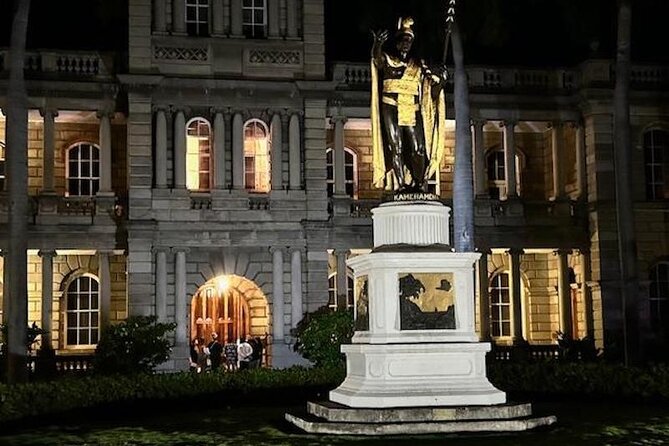
The tour starts at the King Kamehameha I Statue, and that’s a smart move. Conquest is not a “quick chapter.” It’s the start of a whole era, and the island’s future depends on it.
You’ll get the amazing—and horrifying—story behind the conquest of Oahu by Kamehameha. The point isn’t just who won. It’s how power got reorganized, and how ordinary lives got pulled into that shift.
If you’re used to Hawaii being explained as myth and romance, this opener hits a different note. And that’s exactly why it works. It sets the tone: this is history with consequences.
Stop 2: Iolani Palace—royal glamour in the middle of U.S. history
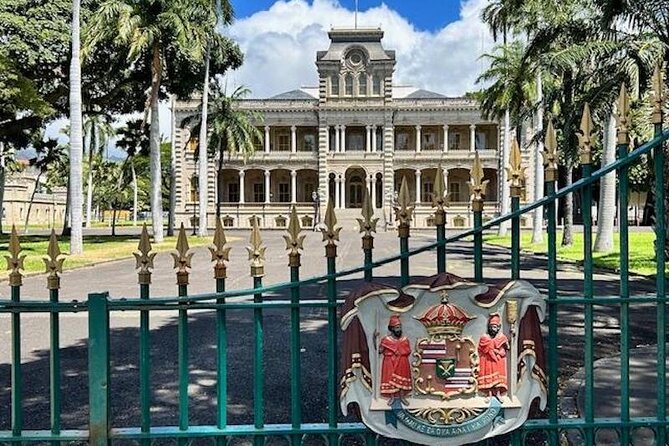
Next comes Iolani Palace, where you get to imagine a royal court inside the United States. That alone is worth the stop—then you add the story of how the monarchy ended.
The palace is the tour’s political center of gravity. You’ll hear context about what made the Hawaiian monarchy significant, how it functioned, and how the overthrow changed everything. It’s the kind of explanation that helps you connect names and dates to real places you can stand in front of.
This is also one of the two sites where admission is not included. So if you want to go inside rather than just view the exterior and hear the story, plan to grab the ticket on your own.
Stop 3: Kawaiaha’o Church and the missionary-era conflict written in stone
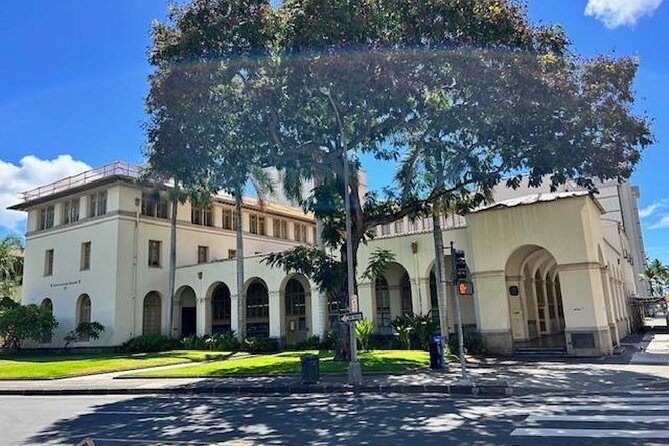
Kawaiaha’o Church is where the tour leans into religion—and the tension around it. The church was designed by Hiram Bingham, a name you’ll hear again when you start reading about the missionary era in Hawaii.
You’ll hear why this stone church looked like something new to missionaries, but why it was anything but to many Hawaiians. In other words: the same walls can mean different things depending on who’s looking and what they lost.
This stop is free, and it’s short—so don’t rush it. Give yourself a moment to notice the setting and scale, then connect it to the story you just heard about the power shift.
Stop 4: Hawaiian Mission Houses Historic Site and Archives—what “doing good” really meant
After the church, the tour moves to the Hawaiian Mission Houses Historic Site and Archives. This stop helps you understand the missionary presence not just as sermons, but as a system that built institutions, recorded documents, and shaped daily life.
Here’s the angle: you’ll hear a version of the story that treats the missionaries as active players. The framing is that they came to do good, and they did very well—meaning they succeeded at creating lasting structures.
This stop is also free and brief, which makes it a good fit in the tour’s tight timing. You get the gist without getting buried in details.





Stop 5: Honolulu Hale—pretty architecture with a darker past
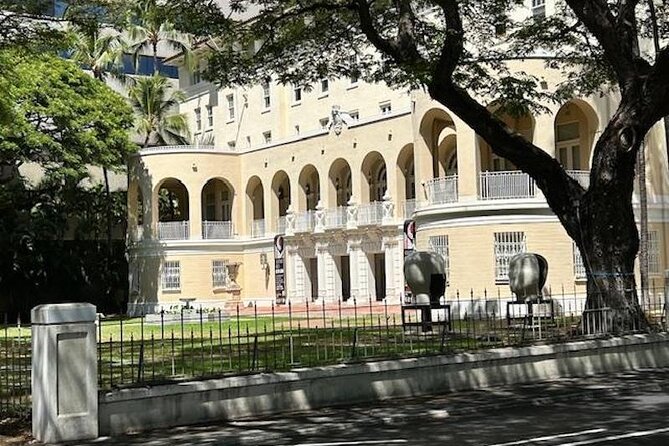
Honolulu Hale is next, and it’s hard to miss. It’s a lovely Italianate Spanish Colonial Revival structure. The outside looks calm and composed, like it belongs in a postcard.
The catch is the past. The tour shares an unlovely side to the building’s story, reminding you that civic spaces can carry political baggage. This is where the tour nudges you to question first impressions.
This stop stays quick and free, so use it as a mental “reset.” Let the architecture catch your eye, then let the history correct your assumptions.
Stop 6: Hawaii State Capitol—aloha ideals and the statue with a story
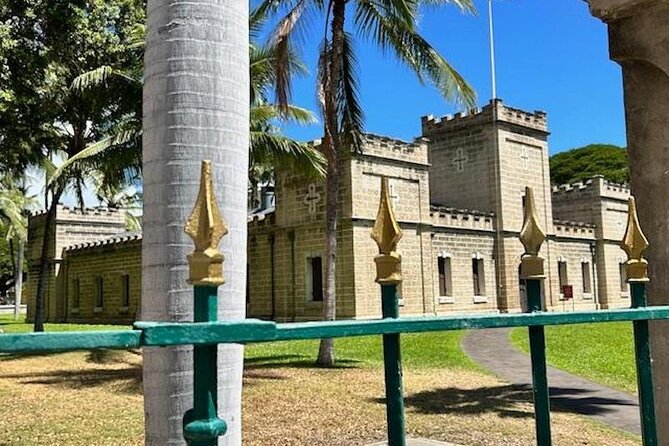
At the Hawaii State Capitol, the tone shifts again. You get an elegant expression of the aloha spirit—but you also get a reminder that values get expressed in public art, laws, and institutions.
You’ll also hear the story behind a statue tied to the queen who embodied that spirit. That matters because the monarchy story isn’t only about loss. It’s also about ideals that survived, even when political power didn’t.
Like a good tour should, this one doesn’t leave you with abstract admiration. It connects the symbol to the person, and the person to the time period.
Stop 7: Washington Place—Liliuokalani’s home after the overthrow
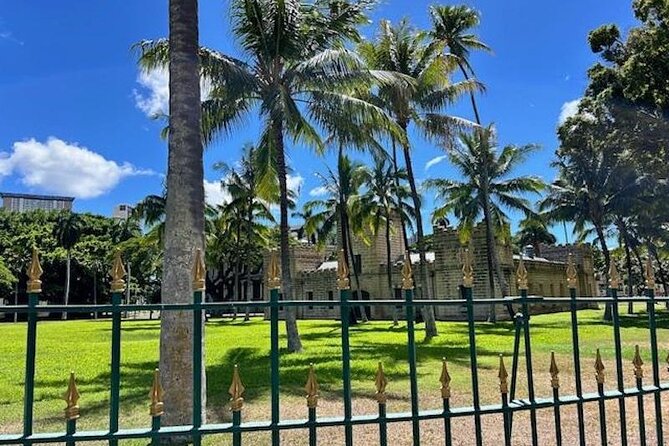
Washington Place is where the tour brings the monarchy story back to a personal level. This is Queen Liliuokalani’s home, where she lived in an unhappy marriage—and where she returned after the overthrow of the monarchy.
That combination of private hardship and public catastrophe makes this stop hit harder than you might expect from a quick city walk. The building becomes more than a landmark. It becomes a place tied to resilience and disruption.
This stop is free and short, so don’t expect a long pause. But if you’re the type of person who likes to stand and picture what life might have felt like inside these walls, this is one to linger for 30 extra seconds.
Stop 8: Cathedral of St. Andrew—English sandstone, stained glass, and tragedy
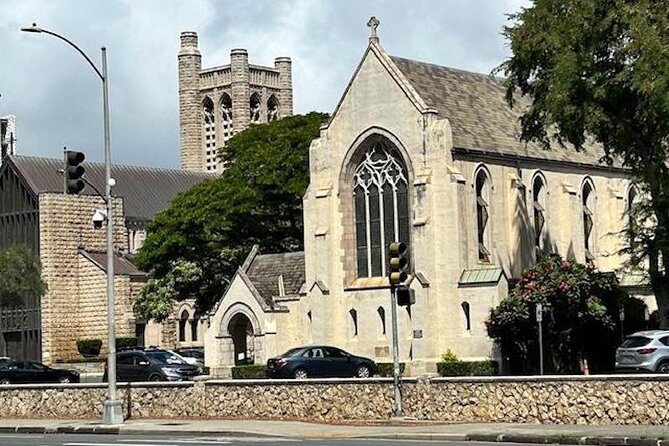
The Cathedral of St. Andrew adds a different kind of drama. You’ll hear that it’s built from thousands of blocks of sandstone cut in England and shipped to Hawaii, which is a detail most people never think about when they see the finished church.
Then there’s the stained glass nave, which you’ll experience as “wow” material without needing to be a church expert. It’s also tied to story and memory, not just design.
The tour includes a tragic tale involving a king and his little boy. That kind of story turns a church stop into something more like a historical film scene.
This stop is free, and it’s only around five minutes in the itinerary, so make your quick glance count. Look up at the stained glass and then listen for what it symbolizes in the narrative.
Stop 9: Capitol Modern (Hawai’i State Art Museum)—the original Royal Hawaiian Hotel
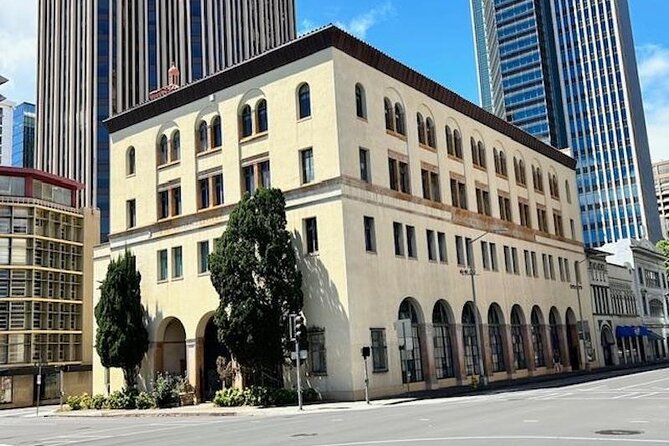
Capitol Modern is also known as the Hawai’i State Art Museum, and the building’s history is a big reason it works on this tour. It was the original Royal Hawaiian Hotel, built in 1872—and it was so successful that a second Royal Hawaiian was built on Waikiki Beach, the Pink Palace.
That hotel story matters because it connects politics and culture to tourism, money, and the changing face of Honolulu. The monarchy might be the main thread, but the world around Honolulu kept shifting too.
Admission here is not included, so if you want to go inside to see the museum spaces, you’ll need to plan for that separately. If you’re content with the exterior context and the guide’s explanation, you’ll still get the point.
Stop 10: Ali’iolani Hale—where the Massie Affair played out
The final stop is Ali’iolani Hale, now the Judiciary Building and home to the Hawaii State Supreme Court. This is where the tour lands on the legal aftermath—who had power, who fought for justice, and how governance worked in practice.
You’ll hear about the Massie Affair, described as the marquee event of Hawaiian jurisprudence. The tour uses it to show how the island’s legal system intersected with conflict and authority.
This stop is free and quick, but it closes the loop well. You’ve seen the monarchy, the institutions, and the civic buildings. Now you see the courtroom side of the story.
What makes this tour worth the $39 price tag
At $39 per person for about 1.5 hours, this tour lands in the “serious value” category for what you get: a guided narrative built around major sites you’ll likely visit anyway. The key is that you’re paying for interpretation, not just walking between landmarks.
Two stops require paid admission (Iolani Palace and Capitol Modern). That’s the main “cost variable,” and it’s worth thinking about before you book. If you want to enter both, budget a bit more. If you’re happy to learn from the outside and focus on the story, you can keep your spend controlled.
The small group cap also makes the price feel more fair. You’re not paying for a huge group lecture—you’re paying for a guide who can keep the thread coherent from start to finish.
And if you care about tone, this tour does something unusual. It doesn’t pretend Hawaiian history is only happy. It includes tragedy, conflict, and the emotional weight behind major events. That honesty is why people rate it so highly and keep recommending it.
A slightly spooky bonus: stories that add atmosphere (not just facts)
One of the more memorable parts of this experience is that it includes ghostly sightings and spooky storytelling. That doesn’t mean you’re being asked to believe every tale like a fairy story.
Instead, the effect is atmospheric. When you’re standing in historic places tied to power shifts and grief, the ghost stories make the atmosphere feel more alive. If you like history with a bit of theater and humor, this part can be great.
If you prefer only straightforward facts, you might find the mood shifts a little. Still, the core focus stays on Hawaiian history and what these buildings mean.
Practical tips so you enjoy every stop
This is a walking tour with lots of standing. You’ll be moving from site to site rather than settling in. I’d wear comfortable shoes and dress for shifting weather.
The good news is that assistance is available for those who need help with stairs or inclines. The tour is also designed for most travelers, and service animals are allowed.
You’ll also want to know two helpful logistics details. First, you’ll receive a mobile ticket. Second, the start point is at the King Kamehameha I Statue at 447 S King St, Honolulu, and the tour begins at 10:45 am.
Try to arrive a few minutes early so your first stop doesn’t feel like a sprint. And if the sun shows up, you’ll appreciate that the guide tries to keep people in shade when possible.
Who should book this Honolulu history walk
This tour is perfect for you if you:
- love history explanations that connect buildings to real events
- want Hawaiian monarchy context that goes beyond basics
- enjoy guided storytelling, humor, and occasional spooky atmosphere
- plan to spend time in downtown Honolulu anyway
It may not be the best match if you:
- need frequent seating breaks because the pace includes standing
- only want sites with included admission, since Iolani Palace and Capitol Modern are ticketed separately
Should you book this Honolulu history tour?
If you’re choosing between seeing landmarks and actually understanding them, book this. The value is in the narrative thread—from Kamehameha’s conquest context to the monarchy’s end, then through missionaries, churches, civic buildings, and the courtroom sites afterward.
This is also a great choice when you want to balance your Hawaii trip. Surf culture and beaches are the obvious highlights, but this adds the political and spiritual layers that shape the islands people talk about every day.
If you plan to visit both Iolani Palace and Capitol Modern inside, budget for those admissions and you’ll get the fullest experience.
FAQ
FAQ
How long is the Honolulu tour?
It runs for about 1 hour 30 minutes.
Where does the tour start?
It starts at the King Kamehameha I Statue, 447 S King St, Honolulu, HI 96813, USA.
What time does it begin?
The start time is 10:45 am.
Is the tour offered in English?
Yes, the tour is offered in English.
How much does it cost?
The price is $39.00 per person.
Is admission included for Iolani Palace and Capitol Modern?
No. Iolani Palace and Capitol Modern are listed as admission ticket not included. The other stops are listed as free.
What stops are included on the route?
The tour includes King Kamehameha Statue, Iolani Palace, Kawaiaha’o Church, Hawaiian Mission Houses Historic Site and Archives, Honolulu Hale, Hawaii State Capitol, Washington Place, Cathedral of St. Andrew, Capitol Modern (Hawai’i State Art Museum), and Ali’iolani Hale.
Is this tour walkable, and is assistance available?
Most travelers can participate, and assistance is available for those who need help with stairs or inclines. The tour includes a fair amount of standing.
Are service animals allowed?
Yes, service animals are allowed.
What is the cancellation policy?
You can cancel for a full refund up to 24 hours before the experience’s start time. Free cancellation is available as long as you meet that 24-hour cutoff.