REVIEW · OAHU
Oahu Off the Beaten Path Small-Group Tour from Honolulu
Book on Viator →Operated by Spiritual Tours Hawaii · Bookable on Viator
Want Oahu with fewer beach clichés? This half-day small-group tour connects you to Oahu’s heritage through lookouts, temples, heiau, and memorial sites. You’ll cover big viewpoints like Makapu‘u Point and mix in spiritual and cultural stops that most first-timers skip.
I especially like the way the guide brings together local history, geology, and spiritual practices without turning it into a lecture. I also like the pacing: each stop is long enough to get oriented and appreciate the place, yet short enough to see a lot in about half a day.
One consideration: time at each location is brief (think 15–25 minutes), and the Byodo-in Temple admission is not included, so budget a little extra if you want to go inside.
In This Review
- Key highlights you’ll feel right away
- Why This Half-Day Route Works on Oahu (Even If You’re Short on Time)
- Small-Group Comfort, Mercedes Van, and the Role of Local Guides
- Makapu‘u Point: The Bulging Eye Lookout With a God-Story
- Kaka‘ako Waterfront Park, Whales Chamber, and the Point Panic Nickname
- Byodo-in Temple Hawaii: A 1968 Tribute With Real Gravitas
- Ulupo Heiau State Monument: Menehune Legends and High Chiefs
- He‘eia State Park and Ke‘alohi Point: Plants, the Oldest Fish Pond, and Living History
- Kahi Hali‘a Aloha Memorial: Where Respect Is the Main Attraction
- Price and Value: What $144 Gets You (and What It Doesn’t)
- Timing, Dress Code, and What to Pack for a 9am Start
- Who This Tour Is Best For
- Should You Book This Oahu Off-the-Beaten-Path Tour?
- FAQ
- How much does the Oahu Off the Beaten Path Small-Group Tour cost?
- How long is the tour?
- What time does the tour start?
- Where do I meet the tour?
- How large is the group?
- What language is the tour offered in?
- Is Byodo-in Temple admission included?
- What’s included in the price?
- What should I wear, and is there an age limit?
- What is the cancellation policy?
Key highlights you’ll feel right away
- Small group attention with room to ask questions and get personal context
- Makapu‘u Point storytelling that starts with the meaning of the place-name
- Byodo-in Temple as a living tribute to Japanese immigration history
- Heiau and sacred memorials handled with respect and care for cultural meaning
- He‘eia State Park with the oldest fish pond on Oahu and plant history
Why This Half-Day Route Works on Oahu (Even If You’re Short on Time)
Oahu can feel like two different islands at once: postcard beaches on one side, and deep cultural places on the other. This tour quietly stitches those together. In a single morning, you get big views plus the slower, human side of Hawaii—how people once lived here, what they believed, and how the land shapes daily life.
You’re also not stuck in “look, then leave” mode the whole time. With a maximum group size of 20, the guide can slow down when it matters, and speed up when it doesn’t. That balance is a big deal if you don’t want your day to feel like a conveyor belt.
If you love context—why a lookout matters, why a temple was built, why a heiau is treated with care—you’ll probably find the whole route satisfying. If you’re the type who wants hour-long stops at every site, you may feel rushed. I’d plan to use this tour as the cultural backbone of your Oahu trip, not as your only “see everything” plan.
You can also read our reviews of more tours and experiences in Oahu.



Small-Group Comfort, Mercedes Van, and the Role of Local Guides
The logistics are simple and the ride is comfortable. You meet at the Honolulu Zoo (151 Kapahulu Ave) at 9:00 am, and you ride in an air-conditioned vehicle. Many days on Oahu are hot and bright, so having that comfort matters more than it sounds.
What makes this experience click is the guide approach. Guides such as Ama and Simina have led this tour, and both are described as giving strong local and historical context with real patience. Simina is also noted as very attentive to everyone’s needs and security-conscious, and that shows up in how the group moves between stops.
Because the group stays small, you can get a more natural rhythm:
- You’re more likely to ask a question without shouting over a crowd.
- The guide can adjust stops when the moment calls for it.
- Everyone stays aware of where the group is headed next.
That’s the “off the beaten path” part you can actually feel: not just lesser-known spots, but also the calmer way you visit them.
Makapu‘u Point: The Bulging Eye Lookout With a God-Story
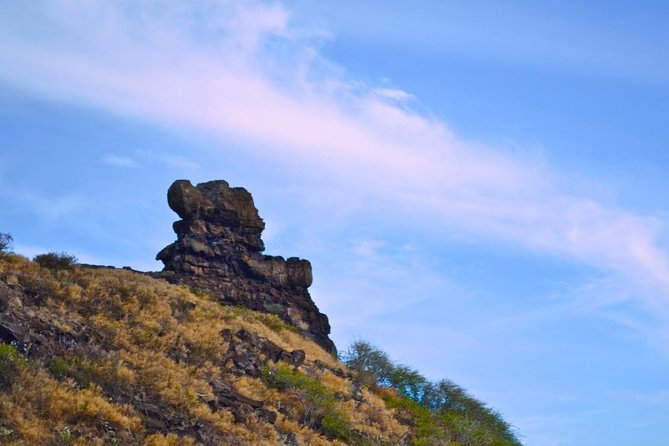
Makapu‘u Point is your first wow moment, and it’s not random. The viewpoint is one of Oahu’s most beautiful lookouts, and the name itself sets the tone.
Makapu‘u means bulging eye in Hawaiian. The story goes further: it was named after a Tahitian god who lived in a cave nearby and had eight bright eyes. That kind of detail does more than entertain. It changes how you look at the place, because you’re not just scanning for a horizon. You’re imagining why humans gave this landscape meaning in the first place.
Stop length is about 15 minutes, so you’ll want to do the practical things fast:
- Have your camera ready.
- Decide early if you want the first quick photo or a longer look.
- Don’t overpack the time. The best payoff here is the view plus the story, not a long hike.
Even if you’ve seen photos of Makapu‘u, the added cultural layer is what makes this moment worth a place on your schedule.
Kaka‘ako Waterfront Park, Whales Chamber, and the Point Panic Nickname
Next you move to Kakaʻako Waterfront Park, also known as Point Panic Park. The name makes it sound chaotic, but the atmosphere you’ll get is more “cool public artwork + city energy + ocean air.”
The standout detail is the spiral of the Whales Chamber. It’s the kind of structure that gives you something to notice up close, even if you’re not there for a long walk. It also works well as a mental reset after Makapu‘u: you go from dramatic open views to a creative shoreline pocket near downtown.
This stop runs about 20 minutes, which is perfect for:
- a quick walk-through,
- photos that don’t require planning gear,
- and a moment to connect the ocean to today’s Honolulu.
If you’re hoping for a quiet nature escape, this isn’t that. But if you like understanding how island culture sits alongside modern city life, this stop does the job.
Byodo-in Temple Hawaii: A 1968 Tribute With Real Gravitas
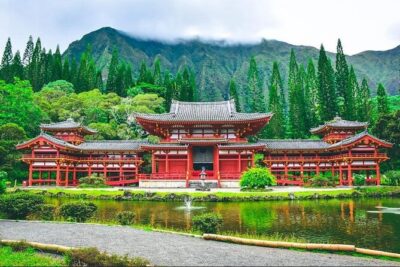
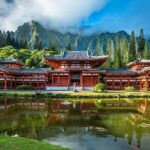
Byodo-in Temple Hawaii is where the tour becomes more clearly spiritual. It’s located at the foot of the Ko‘olau Mountains in Valley of the Temples Memorial Park.
Here’s the context you’ll care about: the temple was established on June 7, 1968, to commemorate the 100-year anniversary of the first Japanese immigrants to Hawaii. It’s a smaller-scale replica of the original Byodo-in Temple in Uji, Japan—an over 950-year-old site that’s recognized as a United Nations World Heritage Site.
That means you’re not just seeing pretty architecture. You’re seeing a community story carried through place and design. The guide’s explanations matter here, because they help you read the temple as an act of memory and continuity, not just a sightseeing stop.
Two practical notes:
- Admission to the temple is not included in the tour price, so plan for that extra cost.
- Stop time is around 25 minutes. If you want to take your time inside, consider arriving with a slow mindset and focus on a few key areas rather than trying to absorb everything.
If you’ve never visited a Buddhist-style temple on Oahu before, this is a strong starting point because the historical explanation ties it to human migration and identity.


Ulupo Heiau State Monument: Menehune Legends and High Chiefs
Ulupo Heiau State Monument is one of the stops that makes you slow down, even when the clock says 15 minutes. This site has layers of legend and later historical association.
The location is tied, in legend, to the menehune—those small people from Hawaiian folklore who are often linked to building feats. Later, it’s associated with high chiefs of Oʻahu such as Kakuhihewa in the 15th century and Kualiʻi in the late 17th century.
The way you interpret a heiau is different from how you interpret a museum. Here, you’re dealing with sacred space. The guide’s job is to keep you respectful and help you understand why the site holds meaning beyond the stories.
A short stop works if you do one thing: focus on learning what makes it sacred. Don’t rush through for photos only. Give the place a bit of mental attention so the story actually lands.
He‘eia State Park and Ke‘alohi Point: Plants, the Oldest Fish Pond, and Living History
On the windward side of Oahu, He‘eia State Park (at Keʻalohi Point) shifts the tour from legends and memorials into environmental and community history. You’ll learn about the area’s significant changes over time, and you’ll hear about the plant history—both indigenous plants and Polynesian introduced plants.
Then comes one of the most specific, memorable details: you’ll see the oldest fish pond on Oahu and learn why it matters.
That’s a big deal for anyone who wants more than scenic stops. Fish ponds aren’t just farming relics; they show how people managed resources using careful knowledge of water, tides, and local conditions. If you care about how island life worked before modern development, this is one of the stops that gives you something real to carry home.
Stop time is about 20 minutes, and that’s just enough to appreciate the pond and understand the “why” behind it. You won’t have time to explore every angle like you would on a longer independent visit, so use the guide’s explanation as your cheat code.
Kahi Hali‘a Aloha Memorial: Where Respect Is the Main Attraction
The last stop is Kahi Hali‘a Aloha, described as the place of loving remembrance. This is a memorial designed by the lineal descendants to accommodate Hawaiian ancestral remains.
It’s also noted as the first of its kind to offer permanent and dignified protection to generations of Hawaiian ancestral remains. That’s not a casual line. It’s the heart of what you’re being asked to understand here: the land is connected to ancestors, and protection means more than physical care—it means honoring identity across time.
This stop runs about 20 minutes, and it’s the most “quiet” moment on the route. If your instinct is to treat it like another photo stop, resist that urge. Give it a few minutes of calm attention so the meaning becomes clear.
When a tour ends with a memorial like this, the whole trip tends to feel more coherent. You started with a lookout story, moved through faith and community, and ended with the ongoing presence of ancestry in the landscape.
Price and Value: What $144 Gets You (and What It Doesn’t)
At $144 per person for about 5 to 6 hours, you’re paying for a guided route that’s not just driving from place to place. You’re getting:
- an air-conditioned vehicle,
- a driver/guide and local guide support,
- bottled water,
- and coverage of fuel surcharge plus landing and facility fees.
Most stops have admission ticket free access, which keeps the cost from spiraling. The one notable exception is Byodo-in Temple Hawaii, where admission isn’t included. So the real “all-in” number depends on what you choose to do inside that temple.
Is it good value? For me, it lands in the sweet spot because the tour is small enough to feel personal and the stops include meaningfully different kinds of places: ocean view, sacred temple, heiau site, fish pond history, and an ancestral memorial.
If you’re traveling solo or want a low-effort way to see more than the standard beach loop, this price is easier to justify. If you’re the type who prefers self-guided wandering with unlimited time at each site, you might feel the half-day format is too structured for your taste.
Timing, Dress Code, and What to Pack for a 9am Start
You start at 9:00 am and return to the meeting point. Expect a steady flow of stops rather than long hikes or extended museum time.
Dress code is smart casual. That’s a helpful guide for planning what you wear, especially since some stops are more respectful spaces. Comfortable walking shoes matter. Bring sun protection as well, since parts of the route include viewpoints and outdoor public areas.
You’ll also want to come with a good mindset: this tour is built around stories—history, geology, and spiritual practices. The payoff is higher if you’re ready to listen instead of treating it like a drive-by checklist.
Who This Tour Is Best For
This is a great fit if you want to understand Oahu beyond the obvious. You’ll especially like it if:
- you’re interested in cultural sites and respectful storytelling,
- you appreciate short stops that are still meaningful,
- you want small-group attention rather than a large bus.
It’s also a smart option for couples, friends, and first-timers who want an efficient half-day with variety. The minimum age is 18, so it’s geared toward adults.
If your top priority is long beach time or lots of free time with no guidance, you may prefer a different style of outing.
Should You Book This Oahu Off-the-Beaten-Path Tour?
Yes, if you want a guided half-day that links viewpoint beauty to cultural meaning—without dragging on all day. The combination of small-group pacing, guide-led context, and respectful stops (temple, heiau, memorial) is what makes this stand out in a good way.
Hold off only if you strongly prefer long, self-paced visits at a single site, or if paying extra for Byodo-in Temple admission would bother you. For most people doing an Oahu itinerary, this tour is a solid use of morning time that adds real depth.
FAQ
How much does the Oahu Off the Beaten Path Small-Group Tour cost?
It costs $144.00 per person.
How long is the tour?
The tour is about 5 to 6 hours.
What time does the tour start?
The start time is 9:00 am.
Where do I meet the tour?
You meet at the Honolulu Zoo, 151 Kapahulu Ave, Honolulu, HI 96815.
How large is the group?
The tour has a maximum of 20 travelers.
What language is the tour offered in?
The tour is offered in English.
Is Byodo-in Temple admission included?
No. Admission to The Byodo-in Temple Hawaii is not included, while other stops listed are free.
What’s included in the price?
The price includes bottled water, a driver/guide, a local guide, fuel surcharge, and landing and facility fees.
What should I wear, and is there an age limit?
The dress code is smart casual, and the minimum age is 18.
What is the cancellation policy?
You can cancel for a full refund up to 24 hours in advance. If you cancel less than 24 hours before the start time, the amount paid is not refunded. Free cancellation is available up to that cutoff.